I'm pretty sure my parents read nursery rhymes to me when I was little, but I can't quite remember that happening. I do, however remember a creepy egg standing next to an exceedingly creepy man in a nursery rhyme book. And also some goose wearing a bonnet. Years later, in about fifth grade, my teacher decided I would be good at reciting poetry and asked me to read a poem in front of the entire school. For some reason I said yes. Guess you could say that affected me positively by making me overcome stage fright.
However, the only things I could consider "positive" experiences that I've had were recently, and had more to do with music. I think this might be cheating because music isn't exactly considered poetry, but it's the best that I could come up with. Of course, I could also argue that lyrics in some songs are poetry. I believe it all started last year, my English teacher assigned us to find a song and analyze the lyrics for some of the terms on the poetry list we're doing now. It was one of the few projects I actually enjoyed.
A while after this, I found myself looking up lyrics to the songs I liked and being amazed at how the lyrics were so poetic. Most of them at least had rhyme and rhyme scheme. But I also looked at them and tried to figure out what the deeper meaning was, looking it up or asking my friends if I couldn't. A lot of them also had similes and metaphors. Some of them had irony and a lot of them had hyperbole's. I was analyzing song lyrics without even realizing it.
I think this changed me for the better, because I found something educational that entertained me. I tried writing a few by myself, they were alright. It made me look at the music I listen to in a new way (I admit, a majority of it is people screaming at the top of there lungs and slamming on the guitar) and I started listening for poetry in my music. It was a bit like after I learned about counts in music and I started listening for them without noticing it. I think it even improved my taste in music (although many would disagree).
I never really liked actual poetry. Unless you count Dr. Seuss, of course. When I hear the word "poetry" in class it makes me groan internally. But I guess I'm willing to give it a shot.
Saturday, June 4, 2011

Wednesday, May 4, 2011
Connection to Romeo and Juliet
A few weeks ago, I was reading this book called Son of the Mob. The similarities between this and Romeo and Juliet were pretty obvious. The main characters father was a mob boss, and the father of the girl he falls in love with is a FBI agent. Personally, I liked it better than Romeo and Juliet, the characters in the book are modern teenagers so it's easy to relate to, and it isn't written like a poem. But I guess it's nice to know where the idea came from...
Friday, March 25, 2011
Photo Post
I chose this picture (of Anakin Skywalker, if you couldn't tell) because I think it relates to the theme of "becoming a gentleman" (ignoring the fact that later on he turns into Darth Vader). In the picture, it shows Anakin as a child, walking off into the distance, with great expectations awating him. The most important part is that in the picture, he's facing this part alone. Of course he has Obi-Wan (Jaggers) when he get's there, but he has to make the journey by himself.

Wednesday, March 16, 2011
Connections and Picture
It took me a while to think about it but then, suddenly, it came to me: The Lizzie McGuire Movie. It was almost to perfect. Similar themes, similar characters and similar settings...kind of, I mean Romes in Europe, right? Lizzie goes on a school trip to Rome (substitutable for London) with her best friend Gordo, who I think represented Biddy. Lizzie shares a room with her evil class enemy Kate Sanders who resembles Drummle.
When their strict and rude teacher (I would say she's a like Jaggers but that would be a bit of a stretch) takes them to the Trevi Fountain Lizzie meets a famous European pop star Paulo (who totally reminds me of Estella, but he instead uses charm to trick Lizzie) and says she looks exactly like his ex-singing partner Isabella. After sneaking out and spending the next day with him, Lizzie is completley blinded by the new world of the rich and famous he's shown her. This fit's the theme of "Becoming a Gentleman", but with a modern twist. Meanwhile, Gordo lies to cover up Lizzie's absence, which makes Lizzie feel guilty, contributing to the "guilt" theme.
Paulo told Lizzie that he wrote all the music and Isabella lip-synched (which she didn't) and asked Lizzie to preform for her to prevent her getting sued, which relates to the "convict theme" because what he was doing was illegal. Isabella ends up saving Lizzie from Paulo's evil plan and they become friends, which is why she reminded me of Herbert. This part was so similar it almost scared me: In the end Paulo got in trouble, in other words, "Crime and Punishment",
Both of these stories have a big message about humanity. I think it's that people will want what they can't have, or something new or different, or "better" than what they have now. It's also saying that people can be very goal oriented, and won't stop until they get what they want. These stories say that possessions aren't everything and a higher social class won't make you completley happy (although I'm not completley sure that this is true).
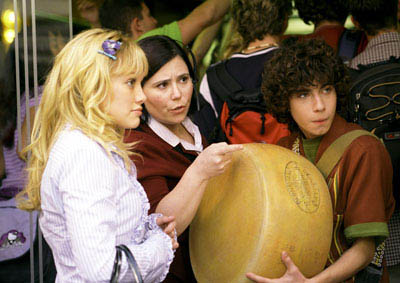
When their strict and rude teacher (I would say she's a like Jaggers but that would be a bit of a stretch) takes them to the Trevi Fountain Lizzie meets a famous European pop star Paulo (who totally reminds me of Estella, but he instead uses charm to trick Lizzie) and says she looks exactly like his ex-singing partner Isabella. After sneaking out and spending the next day with him, Lizzie is completley blinded by the new world of the rich and famous he's shown her. This fit's the theme of "Becoming a Gentleman", but with a modern twist. Meanwhile, Gordo lies to cover up Lizzie's absence, which makes Lizzie feel guilty, contributing to the "guilt" theme.
Paulo told Lizzie that he wrote all the music and Isabella lip-synched (which she didn't) and asked Lizzie to preform for her to prevent her getting sued, which relates to the "convict theme" because what he was doing was illegal. Isabella ends up saving Lizzie from Paulo's evil plan and they become friends, which is why she reminded me of Herbert. This part was so similar it almost scared me: In the end Paulo got in trouble, in other words, "Crime and Punishment",
Both of these stories have a big message about humanity. I think it's that people will want what they can't have, or something new or different, or "better" than what they have now. It's also saying that people can be very goal oriented, and won't stop until they get what they want. These stories say that possessions aren't everything and a higher social class won't make you completley happy (although I'm not completley sure that this is true).
Wednesday, March 9, 2011
Second Stage
The part in the second stage that stood out to me the most was when Pip arrived in London. Ever since Pip had gone to Ms. Havishams and met Estella, he had felt ashamed of the way he looked and about his home. The only thing he wanted was to become a gentlemen, and somehow (the way he inherited his fortune is a mystery) he was able to. When he gets to London, he's dissapointed to find out how flithy and crowded it is. Pip meets the pale young gentleman once again, who helps him learn table manners. Pip's entire outlook on life has been warped by his single goal to become a gentleman.
The second stage of Pip's journey puts a whole new spin on crime and punishment. Not only is Pips new gaurdian an excellent lawyer, the towns people enjoy watching thier fellow inhabitants be convicted of crimes and get publicly hanged. (That could also have a big impact on Pips sense of right and wrong). This has such a big impact because of the contrast of Pips old village and London. Not only is it different in appearance, the people act a bit differently as well. I found that this could also relate to people in our time, say if we we're used to living here in Olympia and we suddenly moved to somewhere like Seattle.
The second stage of Pip's journey puts a whole new spin on crime and punishment. Not only is Pips new gaurdian an excellent lawyer, the towns people enjoy watching thier fellow inhabitants be convicted of crimes and get publicly hanged. (That could also have a big impact on Pips sense of right and wrong). This has such a big impact because of the contrast of Pips old village and London. Not only is it different in appearance, the people act a bit differently as well. I found that this could also relate to people in our time, say if we we're used to living here in Olympia and we suddenly moved to somewhere like Seattle.
Friday, February 25, 2011
Great Expectations Questions
So far the book is kind of confusing. One of the parts I didn't get was when Mr. Wopsle said "Swine were the companions of the prodigal. The gluttony of swine is put before us as an example to the young." But then what I didn't understand even more was when he continued "What is detestable in a pig is more detestable in a boy." (pg. 25). I think he's complaining about how all the children in those days were ungrateful but I don't understand the last part of what he said at all. Does he mean that children are sloppy like pigs? Or worthless? Or just ungrateful? I'm really confused about that and it seems like that could be an important metaphor, so help would be awesome.
Great Expectations Question
So far the book is kind of confusing. One of the parts I didn't get was when Mr. Wopsle said "Swine were the companions of the prodigal. The gluttony of swine is put before us as an example to the young." But then what I didn't understand even more was when he continued "What is detestable in a pig is more detestable in a boy." (pg. 25). I think he's complaining about how all the children in those days were ungrateful but I don't understand the last part of what he said at all. Does he mean that children are sloppy like pigs? Or worthless? Or just ungrateful? I'm really confused about that and it seems like that could be an important metaphor, so help would be awesome.
Saturday, January 29, 2011
Dishonesty in The Importance of Bieng Earnest
I think the main theme of the play is dishonesty. Almost everything the play is at least slightly untruthful and all of the only character that I think didn't lie was Merriman. I think that everything that could possibly have been made fun of in that time period was. One example was when Algernon said to Jack "What a fearful liar you are Jack, I haven not been called back to town." because Algernon came to Jack's house and lied about who he was. Everyone seemed to think that marriage was just a "buisness arangment" and it was common sense that one person in the relationship would always go "Bunburrying". The whole thing is a lie, because the people didn't always go Bunburrying, and Bunburrying is lieing. Also, there was a huge issue going on about the people living in the city bieng more intelligent and "fashionable" than the people who lived in the country, which wasn't neccisarily true. The Earest/Ernest thing is pretty easy to explain. It's really ironic because earnest means honesty and Jack lied about his name being Ernest (and it turns out his name is actually Ernest in the end, but still). The last one, the pursuit of pleasuer is also dishonest, because everyone lies to be happy, yet it's frowned upon to live just for pleasure.
I think that Wilde seems to be saying a lot of things about dishonesty through the play, and most of them have to do with society. I'm not sure whether he's saying it's okay to lie or not though. I seemed like most of the characters lied for pleasure or to get revenge at other people (which also gave them pleasure). All of the dishonesty that the characters had seemed pretty innocent. I think he might have been trying to say that people lie to make their lives better/more interesting. Jack and Algernon just made people up to go and have fun, and Cecily made up Algernon because she was bored and kind of insane. Lane lied for Algernon, but that was because he was working for him. Lady Bracknell lied to cover up the truth from her husband but in the end that was for pleasure too.
I think that Wilde seems to be saying a lot of things about dishonesty through the play, and most of them have to do with society. I'm not sure whether he's saying it's okay to lie or not though. I seemed like most of the characters lied for pleasure or to get revenge at other people (which also gave them pleasure). All of the dishonesty that the characters had seemed pretty innocent. I think he might have been trying to say that people lie to make their lives better/more interesting. Jack and Algernon just made people up to go and have fun, and Cecily made up Algernon because she was bored and kind of insane. Lane lied for Algernon, but that was because he was working for him. Lady Bracknell lied to cover up the truth from her husband but in the end that was for pleasure too.
Subscribe to:
Posts (Atom)